
From the opening moments of “The Batman,” the camera makes the audience work. Unlike other superhero movies, awash with light and the stale colors of the CGI rainbow, director Matt Reeves and cinematographer Greig Fraser embrace darkness, both in tone and the literal blackness that pervades most of the film, often obscuring the viewer’s ability to see Batman and his movements. Robert Pattinson’s rendition of the iconic comic book character is truly a creature of the night, striking fear into and stalking his villainous prey.
In the media build-up to this film, Reeves listed an array of prestigious and ambitious influences for his version of the Batman that both raised expectations for the film and suggested the audience would see a drastically different kind of Batman movie—a true detective film, more in line with Batman’s mystery-solving roots in the comics. Among those influences are “Chinatown,” “The French Connection,” “Taxi Driver,” and “All the President’s Men,” all of which have elements that genuinely appear in “The Batman.”
Reeves and co-writer Peter Craig largely manage to execute their grand cocktail of detective noir, hard-nosed action, psychological thriller, and political corruption, adding in a Zodiac Killer-Esque Riddler and Nirvana needle drops as a garnish. As such, however, there are a lot of moving pieces within the film’s plot.
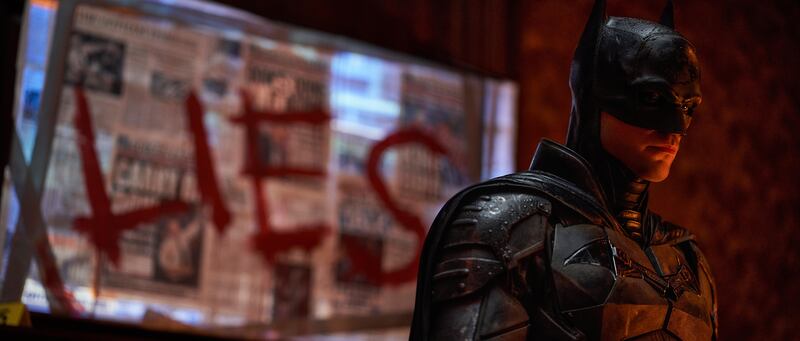
Reeves requires considerable time to explore all of these ideas and influences, so even though “The Batman” runs nearly three hours, the story itself still feels fairly taut. That long runtime demands a lot of the viewer, though, as Reeves never spares showing the gritty details of the Riddler’s murders. Paul Dano’s Riddler is nothing like Jim Carrey’s goofy, spandex-wearing version in 1995′s “Batman Forever”; the new Riddler is intense, creepy and deranged. After certain scenes, one might feel the need for a deep breath or a moment of levity, which, for all its bleakness, the film still occasionally delivers.
Pattinson does not play a talkative or witty hero, but his dry seriousness will still extract a chortle here and there from the audience, especially in the scenes he shares with Colin Farrell’s bombastic Oswald Cobblepot, a.k.a. The Penguin, or Jeffrey Wright’s stoic Jim Gordon, who in this film has not yet risen to the role of Gotham City police commissioner and is one of the few city officials untouched by corruption.
The ensemble’s chemistry serves as one of the film’s most memorable strengths, particularly the connection between Pattinson’s Batman and Zoë Kravitz’s Selina Kyle (alter ego: Catwoman). The pair tussle in acrobatic action scenes while also sharing genuine emotional exchanges that underscore their subtle ideological differences and similarities. While their goals and missions do not align exactly, the two characters have enough common ground to forge a legitimate connection, which Pattinson and Kravitz portray with aplomb even as masks cover their faces.
Batman and Catwoman spend much of their bonding time on the steep overhangs and unfinished silhouettes of Gotham’s skyscrapers, allowing the audience to drink in Reeves’ detailed, ornate Gotham City landscape. Unlike Christopher Nolan’s “Dark Knight” Trilogy, which lifted its geography and design quite heavily and directly from Chicago and New York City, Reeves and his production team melded together elements of different real-life cities to create a tactile Gotham that still feels rooted in its comic book inspiration. Gotham’s gargantuan towers and bridges will remind viewers of Manhattan without ever looking like a carbon copy, the city’s underbelly resembles industrial Chicago, and additional filming in Liverpool and Glasgow provides the cityscape with the older, gothic elements that Nolan’s films lacked.
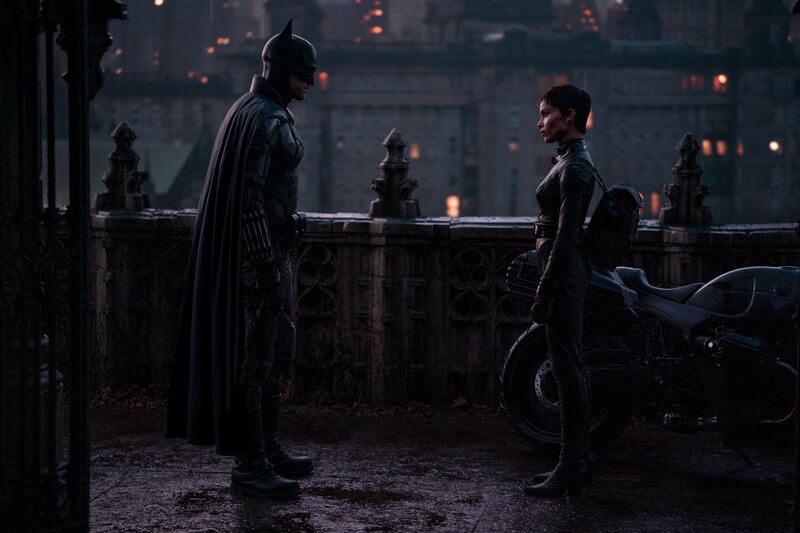
The production designers stitch these disparate parts together seamlessly, such that Reeves’s Gotham feels lived in and beaten down by years of mobster rule and police neglect. The sky pours rain continuously, adding bone-chilling dampness to the already dark and desperate city. Fraser operates in grays and blacks, restricting the use of color for particular scenes, saving his reds and oranges for moments when they will truly pop against a dark and desaturated background. While the film does run long, it allows the viewer to relish Fraser’s gorgeous cinematography. His work is worth the price of admission alone.
Both fans of superhero movies and those skeptical of them should find something to enjoy in “The Batman.” While not always an easy film to watch, Reeves manages to deliver a legitimate auteur-driven superhero movie that leans away from the overreliance on CGI action, pushing the strong performances of its loaded cast, led by Pattinson, to the forefront. He instills plenty of emotion and drive in his performance in both Bruce Wayne and Batman. Audiences should be excited for future Reeves/Pattinson Batman stories, as there’s still so much room to explore this new Gotham and the accompanying journey of its beloved caped crusader.