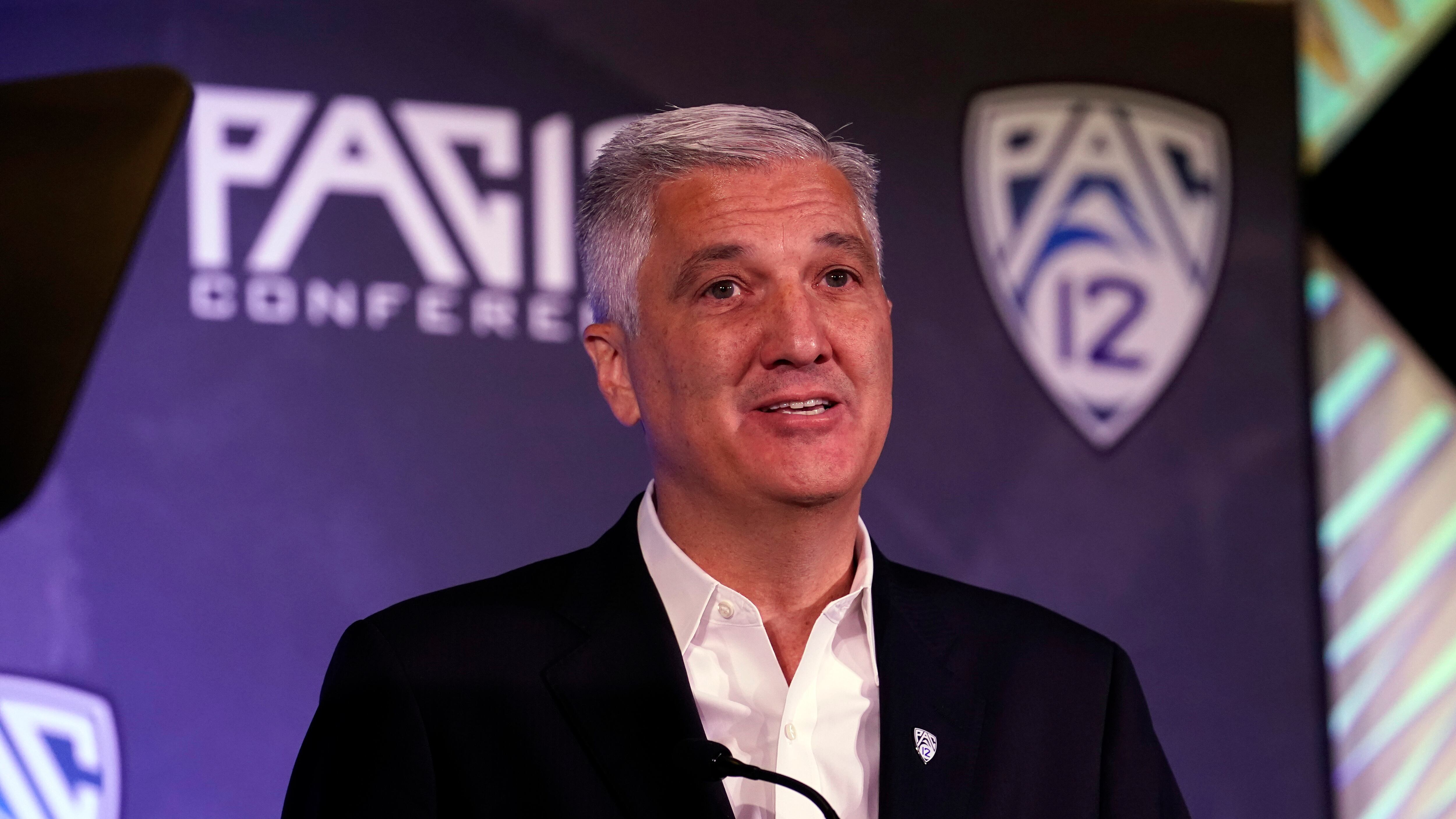
The Pac-12, Big Ten and Atlantic Coast conferences announced Tuesday an alliance geared toward facilitating interconference scheduling and addressing issues in today’s college athletics sphere — including, but not limited to, student-athlete mental health, academic support and social justice.
USC’s Mike Bohn was one of four Pac-12 athletic directors who participated in a cross-conference working group to form the alliance, according to the Los Angeles Times.
“The historic alliance announced today between the Pac-12, ACC and Big Ten is grounded in a commitment to our student-athletes,” Pac-12 commissioner George Kliavkoff said in a statement. “We believe that collaborating together we are stronger in our commitment to addressing the broad issues and opportunities facing college athletics.”
The details on the scheduling aspect remain vague. A joint press release announcing the alliance said that a working group of athletic directors will oversee the scheduling component and that an interconference scheduling alliance will begin “as soon as practical while honoring current contractual obligations.” USC football already has such obligations with several nonconference opponents in the coming years — Rice (2022), Fresno State (2022, 2026, 2028), Nevada (2023), BYU (2023), San Jose State (2024), Ole Miss (2025, 2026) — in addition to its yearly contest against Notre Dame.
Interconference scheduling — which will apply to football as well as men’s and women’s basketball — will offer participating conferences the opportunity to play across different time zones, theoretically expanding conference outreach in terms of recruiting and media rights. The joint statement clarified that future scheduling commitments will “honor historic rivalries and the best traditions of college football.”
The alliance’s position on the future of College Football Playoff expansion — specifically, its position on the optimal timeline for expansion — is unclear. If delayed until 2026, when ESPN’s rights to the CFP terminate, the rights could be bid upon in the open market, whereas prior expansion would give ESPN exclusive rights to extend the current contract. However, immediate CFP expansion would bolster the Pac-12′s chances of breaking into the field; the conference has sent just two teams to the tournament: Washington in 2016 and Oregon in its inaugural 2014 season.
Kliavkoff and Big Ten commissioner Kevin Warren are in favor of playoff expansion, while ACC commissioner Jim Phillips said he is still considering the proposal.
The agreement comes less than a month after the SEC offered membership to Oklahoma and Texas as of 2025. Tuesday’s news is widely perceived as a pushback against the SEC, the preeminent conference with regard to college football dominance.
“There is turbulence in college athletics,” Warren said in a virtual news conference. “There are things we need to address. We need to have strong leadership. We need to work together.”
Kliavkoff echoed a similar sentiment regarding the unspecificity of the scheduling.
“The longer we waited until we announced this alliance, the more details we would’ve had and the more specific on the scheduling,” Kliavkoff told The Athletic. “You balance that against wanting to announce it so that we can start to slow down the vibrations [left by Texas and Oklahoma’s departures to the SEC].”
The alliance is not bound by a legal contract.
“There was an agreement among three gentlemen and a commitment from 41 presidents and chancellors,” Kliavkoff said. “There is no signed document, and there doesn’t need to be. ... We didn’t focus on that, we didn’t even talk about that.”
Kliavkoff told The Athletic that the Pac-12 will announce whether it will expand its number of teams before the end of the week.