
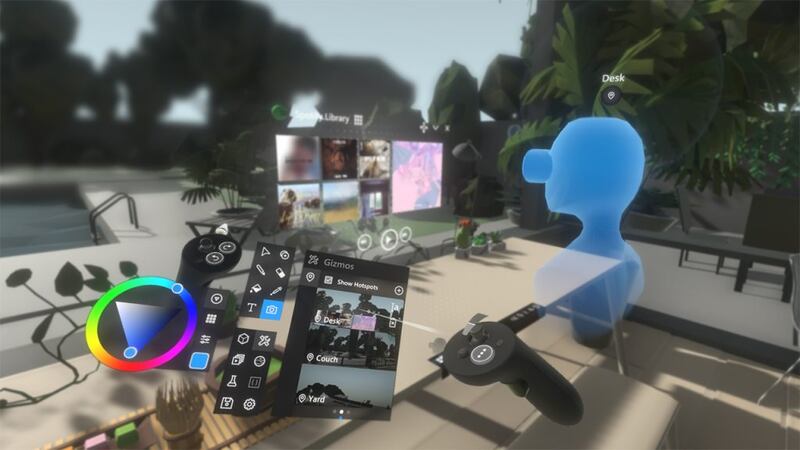
I was God for a couple minutes on Saturday. I was God in a Virtual Reality headset holding two joysticks and fiddling with some virtual plants.
I felt like this back in middle school when I played Minecraft in Creative mode, but this time I wasn’t just staring at my laptop. I was using a system called Marquette, Microsoft’s VR (Virtual Reality) world building tool where you create structures and environments from scratch, using assets and models as you would in any 3-D design engine. It’s supposed to make world building easier, importing your finished space into a project editable in Unity, a 3d development platform for game designers and artists.
The principles behind Marquette were emblematic of the greater ideology of Unity’s message at Saturday’s Developer Day, hosted at the School of Cinematic Arts at USC. Each product, presentation and showcase compounded upon previous generations’ efforts to streamline and simplify the digital creation process. Unity provides independent developers with a platform to create games and products without the need for a massive budget.
Unity is free, at least for now, and appears to be getting bigger according to Rudi Vanzin, a game designer and producer studying at USC.
“It’s heading towards becoming like a Google, right? Where Unity’s going to become a household name essentially. That’s the way it feels especially because at USC we are really pro Unity, so it just seems like everyone is using it even though out in the real world most studios do have their own in house [engine]...” she said.
“I love seeing things be made with Unity because you’re like, oh wow I can do that too.”
This year’s developer day was host to presentations led by designers and developers who displayed the latest technology for developers to implement in their projects. Ashley Alicea, an evangelist for Unity, showcased the Visual Effect Graph, a tool to create richer in game effects like smoke, particles and explosions, while Eli Rarey, a spokesperson for Shotgun, displayed the company’s workflow and feedback tool for design teams.
Outside the lecture halls of SCA were companies displaying their products for people to test. Physical products lined the tables, like the headphones at the Bose audio AR (Augmented Reality) section which detect your head orientation for immersive auditory experiences.
Microsoft showed their AR HoloLens – a tool that lets you see holograms – and their VR Marquette software. Others displayed tools to better manage the business side of Unity like Arm, whose company displays real time, aggregated analytics for developers to identify stress points of their games.

Many of those in attendance were game developers looking to use the technology for better gaming experiences, but some of the tools proved to be useful beyond the realm of entertainment.
Zorne Wang works in the architecture industry, and thinks VR and XR (extended reality) technology can be used to enhance the field.
“For architecture designers, they really need to pick up this technology to improve efficiency, not only work efficiency but communication efficiency for the client,” he said.
Wang stressed the importance of interactivity when it comes to fields like architecture, where half of the job involves showcasing your work to the client, a scenario that could greatly be improved by the adoption of some of these new systems.

But while the products gave opportunities for learning and interaction, the developer’s day was really for the people who use these tools in their daily lives.
Eric Mazer, a volunteer, said that the people in attendance were the most interesting part of the event.
“You get to meet all different people working on different things, and who just like to make stuff. It’s awesome.”
Developers, investors, and creatives alike gathered around the SCA fountain to share with each other their projects and of course, to network.
“I’ve been doing everything by myself, but now I realize that you need a community,” said Leonardo Villagran
He showed me a game he made in his free time. You fly around a 2 dimensional plane in a spaceship, avoiding asteroids and protecting a base from enemies in order to bring light back to a darkened universe. It’s a well made game, but he’s trying to find ways to better market it, and others he wants to make in the future.
“Developers need ideas from anywhere we can. So I started going to the community try to see what’s out there, what people are doing, and try to come out with better ideas myself.”
The Unity community in Los Angeles isn’t that big according to Karter Duff, a game designer and masters student, and events like these provide an opportunity for people with busy schedules to finally come together.
The event left me convinced of the sheer magnitude of possibility inside this tiny box. Every technological advance, and every developer who uses it seems to add another continent to the ever growing digital planet.