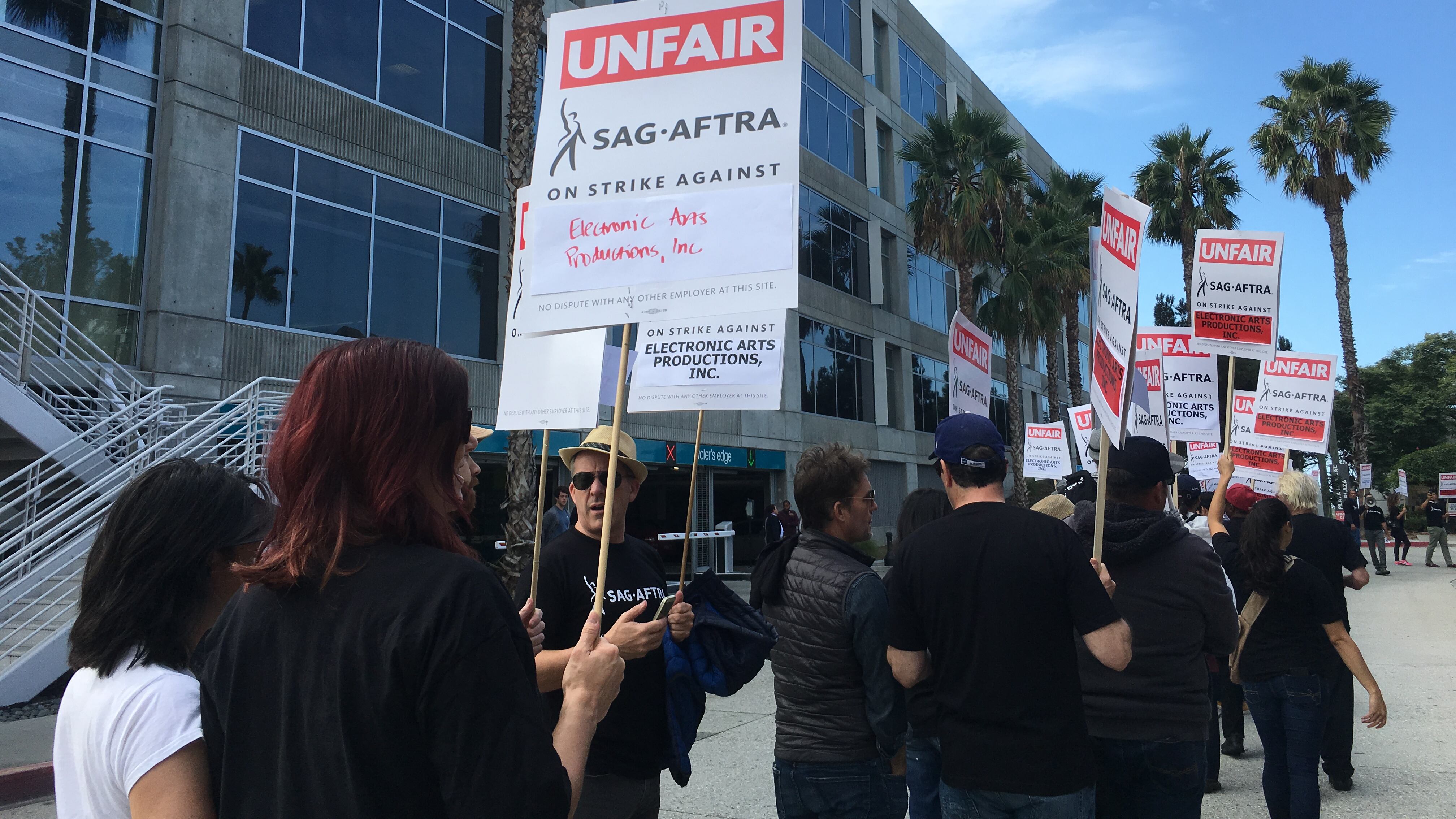
Hundreds of video game voice actors protested outside Electronic Arts on Monday, demanding safer working conditions, more transparency on roles and increased pay for actors who voice high-grossing games. The Screen Actors Guild-American Federation of Television Radio Artists union announced a strike against 11 video game publishers four days ago.
"[Voice acting] can be really difficult work," said actor and negotiating committee member Phil LaMarr. "We're out here because there are safety issues not being addressed as well as simple respect issues, and ideally, we'd love to share in the prosperity we help create."
LaMarr and other SAG-AFTRA members have vowed to stop working for companies like EA, Activision and Disney on projects not started before Feb. 17, 2015, until their concerns are contractually addressed.
Chief among their demands is secondary payments for principle actors who voice high-grossing games. In fact, many of the actors on the picket line Monday said that guaranteeing secondary compensation is their primary aim.
"If a game is wildly, wildly successful, the game companies should share that prosperity with everyone who works on the game," actor and picketer Crispin Freeman said.
The union is also demanding that the new contract ensures more transparency — as members say voice actors are often unaware of what game or character they are voicing — and safer working conditions, such as protection against vocal strain and utilization of stunt coordinators for motion capture projects.
Although the video game industry offered the union a contract that would increase actors' current wages by 9 percent, and 3 percent annually for three years, the union rejected the offer because the proposed contract lacked a payment model that would allow bonuses based on game sales, according to the SAG-AFTRA Strike Center. SAG-AFTRA says that the union is looking for "reasonable secondary compensation" for voice actors whose talents were used in video games that sell over 2 million copies, with up to four bonuses for every 2 million games sold.
While the actors on strike asserted that video game companies have failed to meet their needs, Scott Witlin, chief negotiator and attorney for the video game companies, said the ongoing strike is over an issue of semantics.
"This is an unnecessary strike against the very companies in the video game industry that have the best relationship with SAG-AFTRA and its members," he said at a press conference Monday afternoon.
After nearly two-years of negotiating a contract, Witlin said SAG-AFTRA's proposals have been met, with the exception of video game companies offering "additional compensation" rather than the union's desired "residual compensation."
SAG-AFTRA has until Dec. 1 to accept the video game companies' proposed contract with its current terms.
Reach Staff Reporter Lizzy Gunn here, or follow her on Twitter.
Annenberg Media