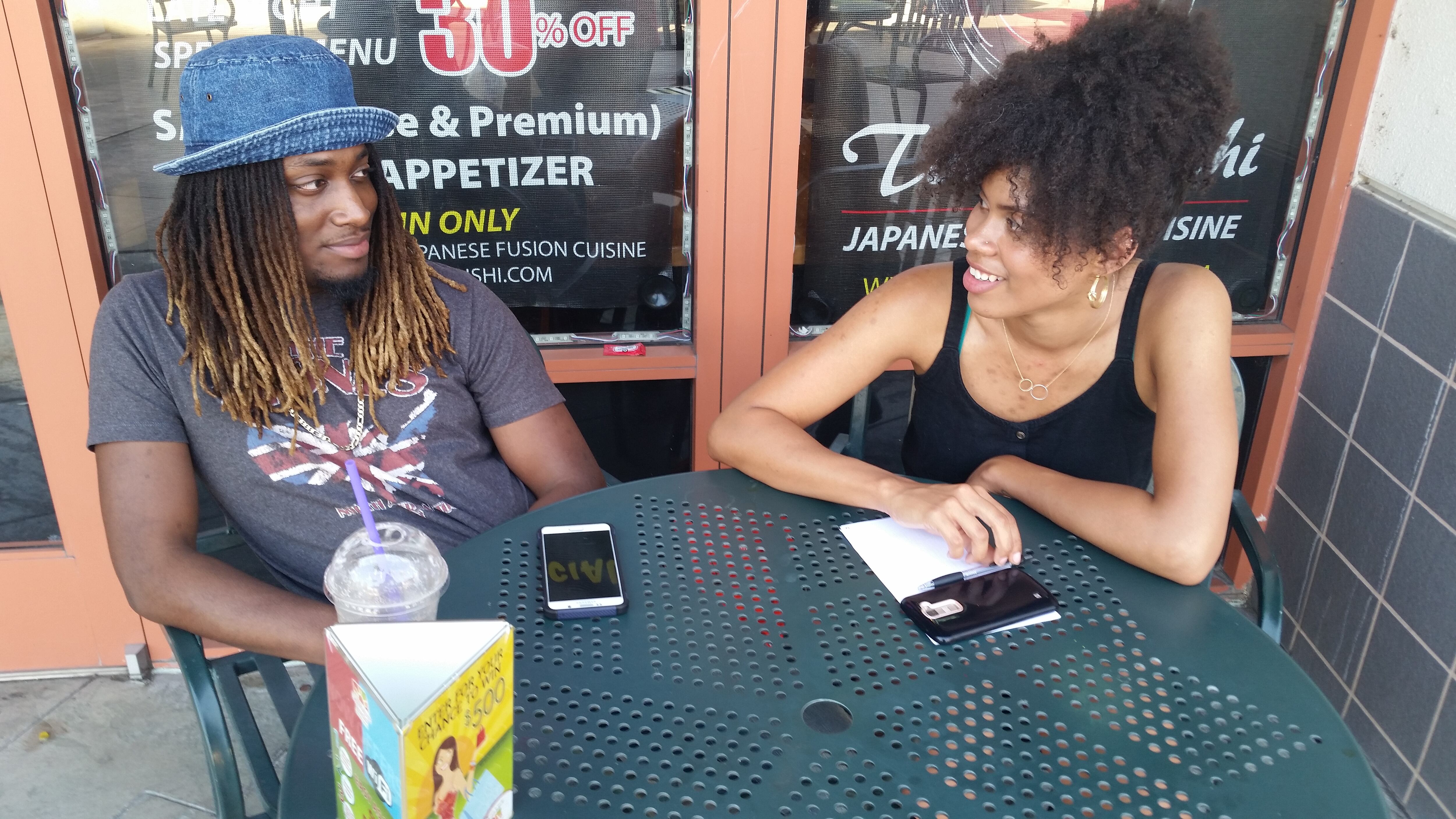
Twenty-five-year-old Tamara French sits across from her new acquaintance, Daniel Stitt, 22, as he sips on an iced coffee on a warm August afternoon.
"We just met today," French says.
They were paired together by family friends.
People usually steer away from heated topics like race, abortion, money and politics on their first meetup. Not these two. Political chatter dominates their first conversation in Northridge.
"Day one, and already so much information," French says.
So far, Stitt and French know they both voted for Bernie Sanders in the primary and now support Hillary Clinton.
"I never thought that Hillary was the lesser of two evils," French says.
French moved to Northridge from Akron, Ohio a week ago to pursue an acting career in Los Angeles.
Stitt, who lives in East Hollywood and is an executive assistant at BET Networks, says he would vote for Sen. Elizabeth Warren if she were running for president, but he nods in agreement.
"I'm with her, and I'm with her (French)," he says as he nods toward French.
They not only agree on Sanders and Clinton, they have similar stances on women's rights, gay rights and immigration.
Support for women's rights comes naturally to French, and also for Stitt, who was raised with four sisters.
"There's great inequality, in perspective to the opportunities that women have versus men," Stitt says. "And that's something that I don't want for my sisters, my [future] daughters or my granddaughters."
They also believe in equality for the LGBTQ community. Both have friends in the community and believe that people should be able to love who they wish to love, that people should be able to feel comfortable in public as who they are and that there's still much work to be done for LGBTQ rights.
The two believe more progress must be made through immigration reform, including citizens' acceptance of immigrants.
French, who has lived in at least seven states stretching from Florida to California, refers to Alexander Hamilton's immigrant status although he was a founding father of the U.S. Hamilton was born in the West Indies. Stitt chimed in that this country was built by immigrants, referring to African slaves, and is still being built by mostly Hispanic immigrants.
However, police brutality, gun control, healthcare and student debt are the most important issues to French and Stitt.
"I always tell people, 'If you're voting and you can't decide on who to vote for, look at your current situation and see which candidate would be better for you,'" says Stitt, who had to take his own advice this election.
French, a registered voter since 2012, says she votes the same way. She assesses a candidate's character and stances on policies and not only party affiliation.
When it comes to social issues, French and Stitt, who are both black, lean toward Clinton's stances on police brutality and gun control. Both are displeased with how Clinton, along with her husband, have dealt with African-Americans in the past. But they see that Clinton tries to empathize with African-Americans and is willing to discuss issues plaguing the community.
One such issue is police brutality and its overlap with gun control. French thinks that getting a gun, even for police officers, should be more difficult. She says people should have to go through psychological evaluations to prevent people with mental illnesses from obtaining guns.
Stitt adds that there's a huge gun culture in America: parents buy their children toy guns, and gun violence is prevalent in entertainment. To solve gun violence, he says we must first change how people think about guns because they are so ingrained in our culture.
Stitt remembers he was taught at a young age to never provoke or run from the police. He said many African-American people run from the police because fear has been ingrained in them from the time of slavery.
"From slave to master relationships, and now from police to black people relationships — it's about people in authority who have power and who abuse that power," Stitt says.
Stitt says he's had negative dealings with the police, but didn't wish to speak about them. French could sympathize with brothers of her own.
"I worry about my brothers all the time because of gun violence," she says. "I never know what's going to happen."
When it comes to healthcare, Stitt is a bit concerned because he is uninsured.
"The worst part is that I think because I'm young I'm invincible, but really I'm not," he says. "I'm worried that something is going to happen and I'm not going to be prepared for it."
French understands. She didn't have healthcare for eight years. During that time, she developed cavities and cysts on her ovaries.
After the Affordable Healthcare Act was passed she received Medicaid, which she used to solve her cavity issue and get the surgery she needed to remove her cysts. The surgery kept her from becoming sterile.
Even now with a clean bill-of-health, French has other bills to worry about.
French, a graduate of Baldwin Wallace University in Ohio, took out student loans amounting to $50,000 to $70,000. She's not alone. Stitt, a graduate of Ohio University, is in student debt by about $40,000.
As relatively recent graduates from college and as people working in the entertainment and arts industry, paying off their student debt is a big issue. Stitt says they'll have to work harder to pay off their debt and to live a decent, quality life.
"But I try not to worry about those things," Stitt says.
They don't see Clinton as perfect. She's the candidate who most closely aligns with their stances on issues, especially issues that matter to them the most like police brutality and gun violence, healthcare and student debt.
"People like to put Hillary down because of some of the more hidden things that have surfaced about her, but I think that's a part of what being a politician is — deciding what's public and what's not," Stitt says. "Only time will tell if she's really about what she says."
Reach Staff Reporter Intisar Seraaj here, and follow her on Twitter.
Annenberg Media